 |
|
Loading...
Searching...
No Matches
|
|
#include <Palette.h>
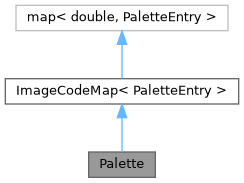

Public Types | |
| typedef std::map< std::string, PaletteEntry > | spec_t |
| Some kind of identity key for the palette, typically filename to avoid reloading. | |
 Public Types inherited from ImageCodeMap< PaletteEntry > | |
| typedef std::map< double, PaletteEntry > | cont_t |
| typedef cont_t::key_type | key_t |
| typedef cont_t::value_type | entry_t |
| typedef drain::LookUp< typename cont_t::const_iterator > | lookup_t |
| LOOK-UP table is an array of pointers to the actual Palette. | |
| typedef std::list< entry_t > | list_t |
Public Member Functions | |
| Palette () | |
| Basic constructor. | |
| Palette (std::initializer_list< std::pair< Variable, PaletteEntry > > inits) | |
| Constructor supporting initialisation. | |
| const value_type & | getEntryByCode (const std::string &code, bool lenient=true) const |
| key_type | getValueByCode (const std::string &code, bool lenient=true) const |
| Shorthand invoking fgetEntryByCode for retrieving the code. | |
| void | reset () |
| void | addEntry (double min, double red=0.0, double green=0.0, double blue=0.0, const std::string &id="", const std::string &label="") |
| Add one color. Deprecating; brace-enclosed initialization more preferable. | |
| void | load (const std::string &filename, bool flexible=false) |
| Loads a palette from text file. | |
| void | loadTXT (std::istream &ifstr) |
| Loads a palette from a text file. | |
| void | loadJSON (std::istream &ifstr) |
| Loads a palette from a json file. Under revision; support may be dropped later. | |
| void | write (const std::string &filename) const |
| void | exportTXT (std::ostream &ostr, char separator='\t', char separator2=0) const |
| void | exportJSON (drain::JSONtree &json) const |
| void | exportFMT (std::ostream &ostr, const std::string &format) const |
| void | exportSVGLegend (TreeSVG &svg, bool up=true) const |
| Returns a legend as an SVG graphic. | |
| void | exportSLD (TreeSLD &sld) const |
| Export as SLD structure supported by GeoServer. | |
| const ChannelGeometry & | getChannels () const |
| Export palette such. | |
| void | refine (size_t n=0) |
| Extend palette to contain n entries ("colors") by adding intermediate entries. | |
| Public Member Functions inherited from ImageCodeMap< PaletteEntry > | |
| ImageCodeMap () | |
| Default constructor. | |
| ImageCodeMap (std::initializer_list< entry_t > l) | |
| ImageCodeMap (const cont_t &map) | |
| Copy constructor //. | |
| lookup_t & | createLookUp (const std::type_info &type, const ValueScaling &scaling) const |
| Creates a vector of 256 or 65535 entries for fast retrieval. | |
| cont_t::const_iterator | retrieve (double d) const |
| cont_t::iterator | retrieve (double d) |
Public Attributes | |
| std::string | title |
| Name of the palette. In reading files, the first comment line (without the prefix '#') is copied to this. Legend shows the title on top. | |
| spec_t | specialCodes |
| size_t | refinement |
| void updateDictionary(); | |
| std::string | comment |
| Public Attributes inherited from ImageCodeMap< PaletteEntry > | |
| lookup_t | lookUp |
| char | separator |
Static Public Attributes | |
| static const SprinterLayout | cppLayout2 |
Protected Member Functions | |
| void | update () const |
| Container for special codes ?? | |
| void | importJSON (const drain::JSONtree &json) |
| Creates a palette from json object. | |
Protected Attributes | |
| ChannelGeometry | channels |
A map of RGB colours, with optional transparency (alpha) values, and with Dictionary support.
| typedef std::map<std::string,PaletteEntry> spec_t |
Some kind of identity key for the palette, typically filename to avoid reloading.
Certain intensities (before scaling with gain and offset) may require special treatment.
| Palette | ( | std::initializer_list< std::pair< Variable, PaletteEntry > > | inits | ) |
Constructor supporting initialisation.
Colorizes an image of 1 channel to an image of N channels by using a palette image as a lookup table.
Having Variable as key type allows mixing numeric codes and alphabetic (special) codes.
Treats an RGB truecolor image of N pixels as as a palette of N colors.
| void exportSLD | ( | TreeSLD & | sld | ) | const |
Export as SLD structure supported by GeoServer.
If the quantity is an integer, do not apply decimal notation.
GeoServer extends the <ColorMap> element to allow two attributes: type and extended.
The <ColorMap> type attribute specifies the kind of ColorMap to use. There are three different types of ColorMaps that can be specified: ramp, intervals and values.
type="ramp" is the default ColorMap type. It specifies that colors should be interpolated for values between the color map entries.
type="values" means that only pixels with the specified entry quantity values are rendered. Pixels with other values are not rendered. Using the example set of color map entries:
type="intervals" value means that each interval defined by two entries is rendered using the color of the first (lowest-value) entry. No color interpolation is applied across the intervals.
The 'extended' attribute specifies whether the color map gradient uses 256 (8-bit) or 65536 (16-bit) colors. The value false (the default) specifies that the color scale is calculated using 8-bit color, and true specifies using 16-bit color.
https://docs.geoserver.org/latest/en/user/styling/sld/reference/rastersymbolizer.html#type
<ColorMapEntry> elements can also have opacity and label attributes. The opacity attribute overrides the global <Opacity> value. The label attribute is used to provide text for legends.
https://docs.geoserver.org/latest/en/user/styling/sld/reference/rastersymbolizer.html#colormap
The simplest <ColorMap> has two color map entries. One specifyies a color for the “bottom” of the dataset, and the other specifyies a color for the “top” of the dataset. Pixels with values equal to or less than the minimum value are rendered with the bottom color (and opacity). Pixels with values equal to or great than the maximum value are rendered with the top color and opacity. The colors for values in between are automatically interpolated, making creating color gradients easy.
|
inline |
Export palette such.
void exportCPP(std::ostream & ostr, bool flat=true) const; Creates a palette from json object
| json | - JSON structure combining optional metadata and compulsory entries section. |
| const Palette::value_type & getEntryByCode | ( | const std::string & | code, |
| bool | lenient = true |
||
| ) | const |
Given code (class index or similar marker), returns the (threshold) value, ie. index of the palette entry.
Argument code is matched against palette entries with tests in the following order:
If a matching code is not found, std::runtime_exeption is thrown.
| code | |
| lenient | - if false, only exact string match tested, else substring match accepted |
getImgLog().setVerbosity(20);
| void load | ( | const std::string & | filename, |
| bool | flexible = false |
||
| ) |
Loads a palette from text file.
| flexible | - if true, try also directory appended with ./palette, basename palette-(string) and extensions txt,json |
| void loadTXT | ( | std::istream & | ifstr | ) |
Loads a palette from a text file.
First label in the file will be the title
| void refine | ( | size_t | n = 0 | ) |
Extend palette to contain n entries ("colors") by adding intermediate entries.
Number of colors.
New number of entries between two current entries.
| size_t refinement |
 1.9.8